
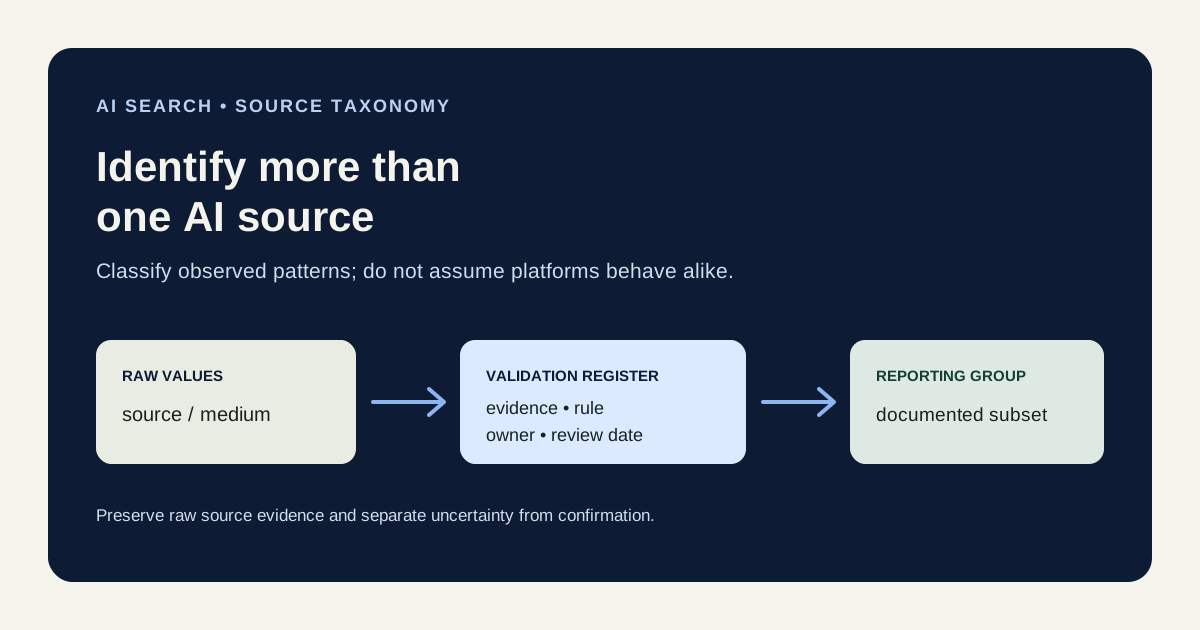
To identify Gemini and other AI search traffic in GA4, build a source taxonomy from the values your property actually receives. Do not assume that Gemini, ChatGPT, or another assistant uses the same referrer format—or passes a referrer at all.
Start with a source inventory, not a universal list
AI-related discovery can come from different products, apps, browsers, and sharing paths. Some visits may carry a recognizable referral source; others may arrive without one or later return through direct or organic search. A static list of expected hostnames can become stale and may falsely imply complete coverage.
Begin by exporting or inspecting the GA4 Session source / medium values for a fixed period. Keep the original values and note how each candidate was found. If you also inspect first-user source or an attribution report, label that scope separately: it answers a different question from session acquisition.
Identify and validate candidate sources
Use a staged review:
- Inventory: List observed source/medium values from referral sessions and relevant landing pages.
- Research: Check whether a candidate host or value is associated with an AI search or assistant product. A name alone may be ambiguous.
- Validate: Compare the source value with landing-page context and, where appropriate and permitted, first-party server/referrer evidence.
- Classify: Mark each item as validated, uncertain, or not AI-related. Record evidence and reviewer.
- Revisit: Review the list periodically and after meaningful changes to source behavior, redirects, or analytics implementation.
| Classification | Include in an AI referral report? | Handling |
|---|---|---|
| Validated source with evidence | Yes, under the documented rule | Keep its exact source value available |
| Plausible but unverified value | Not as confirmed traffic | Investigate or show separately as uncertain |
| Generic, unknown, or internal referral | No, not without evidence | Exclude or classify according to a separate rule |
| Direct / no usable source | No | Preserve as unknown source context |
Do not infer that a visit came from Gemini because it landed on an AI-related article or contained a branded search journey. Those clues may prompt investigation but do not independently prove source.
Build a maintainable taxonomy
Keep two levels of detail:
- Raw source/medium: The values GA4 received, retained for debugging and future reclassification.
- Reporting group: A documented category such as “Validated AI referrals,” derived from explicit matching criteria.
This separation lets you change a grouping without losing the underlying evidence. Store the definition, included values or matching rules, exclusions, owner, effective date, and review date. If a platform changes a domain or referral path, record when the rule changed rather than silently rewriting historical interpretation.
For small volumes, a GA4 Exploration with a filter or comparison may be more transparent than creating a permanent channel. If stakeholders need a stable channel, custom channel groups can help summarize values, but broad conditions can capture unrelated referrals. Validate each rule against raw source rows before sharing the report.
GA4 workflow for multiple AI sources
- Select one GA4 property, date range, and session acquisition scope.
- Add Session source / medium, landing page, sessions, engagement metrics, and the defined key events to an Exploration.
- Review referral rows and capture candidate source values exactly.
- Investigate each candidate independently; do not treat all “AI-looking” labels as the same platform.
- Create a source register with classification, evidence, included pattern, and review date.
- Test filters or channel rules against both included and excluded values.
- Compare AI referral groups with organic search only after matching date range, denominator, and event definitions.
- Report the result as observed referrals under that taxonomy, with unknown visits kept separate.
Avoid using the default channel label as the only evidence. Channel classification may follow configured or platform rules; source/medium is needed to inspect the underlying referral signal.
Consent, browsers, and campaign tags
Analytics consent settings can change what is collected or available for analysis. Consent-related modeling, if available in a particular property and report, is not a validated platform-specific referrer for an individual session. A reduction in recorded referrals may reflect collection or source changes, not necessarily a change in actual discovery.
Browsers, native apps, redirects, and privacy controls can drop or limit referral information. A platform may also send users through different paths. Test only flows that are accessible and appropriate to inspect; do not use one observed path to claim universal behavior.
UTMs are appropriate when you control the link placement and need a consistent campaign identifier. You usually do not control links generated in AI answers, so you cannot depend on tagging those links or on third-party tools preserving UTM parameters. Do not classify untagged traffic as AI by default.
From sources to outcomes—with limits
Once a source taxonomy is stable, analyze landing pages, recorded engagement, and well-defined key events. Compare groups using the same session or user scope and denominator. A platform-specific referral subset may be useful, but it is not all AI-assisted activity and does not prove that a referral caused an outcome.
For the broader measurement framework, see How to Measure AI Search Referral Traffic, the AI Search Analytics guide, and the AI Search Measurement Framework. The AI Search Analytics service can help implement and document the reporting model.
FAQ
Does Gemini always appear as a referral in GA4?
No. Referral behavior depends on the product, navigation path, browser, and whether source information is retained. Use the values observed in your own property.
Should all AI platforms be grouped into one channel?
Only if a shared group supports the reporting question and its membership is defined and validated. Preserve platform-specific source values so analysts can review the group and detect changes.
When should I create a custom channel group?
Consider one when a stable, documented grouping is useful across reports. For investigation or low-volume traffic, a filtered Exploration may be clearer and easier to validate.
Can I identify AI search visits from landing pages alone?
No. Landing pages show where a visit arrived, not necessarily which source caused it. Use them as context alongside source/referrer evidence.
How often should I review an AI source taxonomy?
Set a review cadence appropriate to reporting needs and recheck when new source values appear or existing values change. Record the rule’s effective period to keep comparisons interpretable.
Takeaway
Treat AI source identification as a maintained classification task: inspect actual GA4 values, validate each candidate, preserve raw source evidence, and keep uncertain or unattributed visits separate.
Related cluster reading: Identify ChatGPT traffic in GA4 and track AI search traffic across GA4 and your CRM.
Need a maintainable AI source taxonomy?
Define validated source rules, compare consistent traffic groups, and keep attribution limitations visible in reporting.