
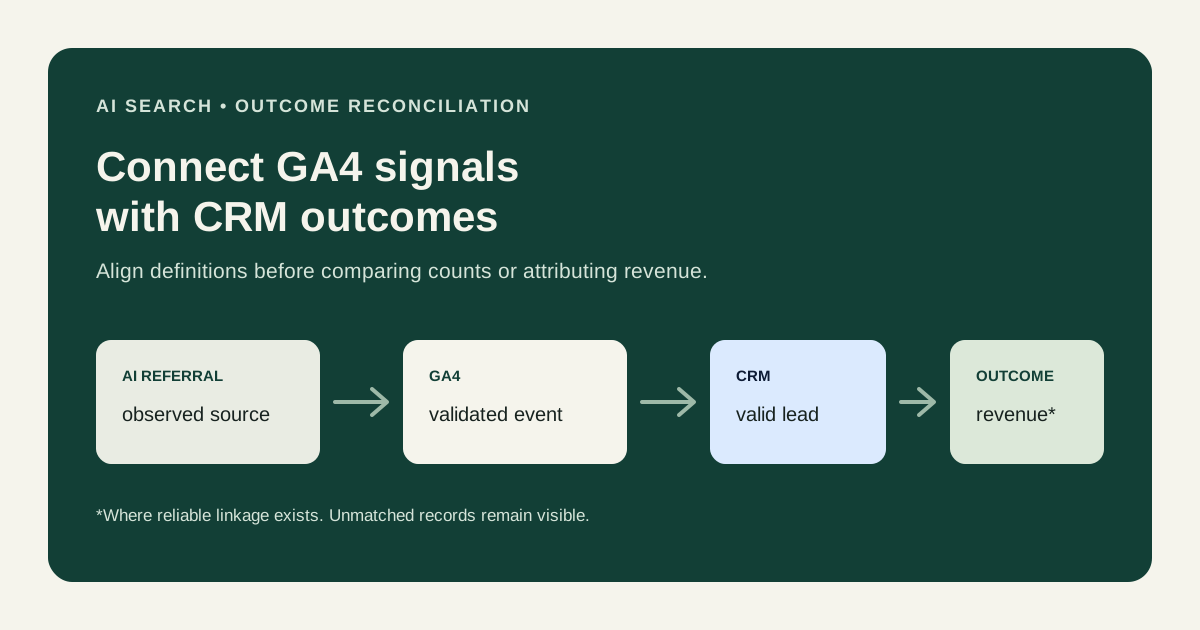
Tracking AI search traffic across GA4 and a CRM means connecting an observable website session and a correctly defined conversion to a business record where a permitted, reliable link exists. It does not mean that every AI interaction can be tracked or that GA4 and CRM totals should match exactly.
First agree what each system counts
GA4 records analytics events and acquisition context it receives and processes. A CRM records leads according to business rules such as successful submission, deduplication, spam review, qualification, and manual or imported entry. These are different measurement stages.
Before reconciliation, define:
| Term | Example definition to agree | Common mismatch |
|---|---|---|
| Observed AI referral | Session with a validated source/referrer rule | Missing or lost referrer is not identifiable as AI |
| GA4 conversion | Event sent after a successful, meaningful action | Clicks, starts, retries, or duplicate events may be counted |
| CRM lead | Record accepted under CRM validation and deduplication rules | Spam, invalid, duplicate, or abandoned submissions may be rejected |
| Qualified outcome | CRM stage reached under an agreed process | Stage timing and qualification definitions differ |
| Revenue | Transaction or opportunity value under the business’s rules | Refunds, delayed closes, currency, and attribution scope differ |
Do not interpret the difference between these counts as a tracking error until you have compared definitions and processing.
Validate the GA4 conversion first
If the website uses a form, measure the successful submission or confirmed completion state—not only the submit-button click. A click can occur before validation fails, a network request is rejected, or the CRM record is created. Check whether reloads, retries, thank-you page visits, or multiple listeners create duplicate events.
Where Google Tag Manager is used, inspect the trigger and dataLayer event that represent the completed action. Test valid, invalid, repeated, and consent-denied flows in an appropriate test environment. For implementation guidance, see Conversion Tracking and Google Tag Manager.
Use event names and parameters that describe the action without placing email addresses, names, phone numbers, or other personal data in GA4. If the site sends a non-identifying lead or submission key for deduplication or reconciliation, confirm its design, access, retention, consent, and platform-policy implications before implementation. Do not send direct identifiers to GA4.
Preserve source context in the first-party workflow
When a validated AI referral arrives, GA4 may receive source and medium information, plus landing-page and session context. If a form is submitted, the website may also capture permitted first-party attribution fields for CRM use. This must be designed consistently with privacy notices, consent choices, data minimization, and applicable legal requirements.
Do not assume you can append UTMs to links inside an AI response. UTMs are suitable for links your organization controls, not a universal method for tagging third-party AI referrals. If campaign fields are stored with a form or CRM lead, distinguish observed values from defaulted, overwritten, or user-entered values.
Consent choices can restrict analytics storage or events. CRM capture may follow a different lawful basis and data policy than GA4 analytics. A missing analytics event does not mean the CRM lead did not exist, and modeled analytics reporting is not a verified identity-level join.
Reconcile GA4 and CRM in stages
Use a reproducible workflow:
- Set the scope: Choose property, timezone, date range, conversion definition, and whether the comparison is by session, event, or lead.
- Confirm collection: Verify successful GA4 events and the source rules used to classify observed AI referrals.
- Define CRM inclusion: Decide whether the CRM count includes all submissions, deduplicated leads, accepted leads, or a later qualified stage.
- Align time logic: Account for timezone, event time, CRM creation time, processing delays, and the date on which a stage changed.
- Match only where allowed: Use an approved stable identifier in a controlled reconciliation workflow. Do not send PII to GA4 or create an unsafe identity join.
- Separate match outcomes: Report matched, unmatched, duplicate, rejected, and unclassified records where those categories can be determined.
- Review source consistency: Compare original GA4 acquisition values with CRM source fields and document each system’s attribution rules.
- Investigate examples: Trace a small, authorized set of records through form, analytics, and CRM processing before interpreting aggregate differences.
- Report outcomes carefully: Show observed referrals, GA4 conversions, CRM leads, qualified stages, and revenue as separate measures with clear denominators.
This process should identify where counts diverge without forcing systems into artificial equality. Some records will have no usable source; some analytics sessions will never become CRM leads.
Attribution and revenue need their own rules
GA4 may assign conversion credit according to the selected reporting identity, acquisition scope, attribution model, lookback settings, and collected touchpoints. CRM source fields may use first-touch, last-touch, self-reported, manually assigned, or operational rules. A “ChatGPT” source in one system may not mean the same thing in another.
For revenue, distinguish ecommerce transactions from lead-generation pipeline or closed revenue. Confirm transaction identifiers, refunds, currency, duplicate handling, opportunity stages, and the date used. Attribute revenue only where the data linkage and model are supportable, and label it as attributed or reconciled rather than caused by AI search.
For wider context, read How to Measure AI Search Referral Traffic, the AI Search Analytics guide, and the AI Search Measurement Framework. The AI Search Analytics service can help scope source definitions, GA4/GTM implementation, reporting, and CRM reconciliation.
Troubleshooting common gaps
- GA4 conversions exceed CRM leads: Check failed submissions, duplicate events, spam filtering, CRM validation, deduplication, and whether clicks or starts are being treated as completed conversions.
- CRM leads exceed GA4 conversions: Check consent, blockers, tag firing, redirects, cross-domain steps, direct/manual entries, phone leads, and imports.
- Source differs by system: Compare the captured source fields, overwrite/default logic, and attribution definitions; do not expect identical channel labels.
- AI source is absent: Keep it unknown unless a separate permitted source provides evidence. Do not infer the source from landing page or CRM outcome alone.
- Revenue appears delayed: Align opportunity/transaction dates, reporting windows, and stage changes before comparing totals.
FAQ
Should GA4 conversions match CRM leads exactly?
Not necessarily. One records collected analytics events; the other applies business validation and processing. Compare aligned definitions and investigate material unexplained differences rather than expecting exact equality.
Can I store a GA4 client ID in my CRM?
Whether that is appropriate depends on consent, privacy notices, legal requirements, platform terms, and the implementation purpose. Assess it with the responsible privacy/compliance stakeholders. Never send direct personal identifiers to GA4.
Can I identify every AI-attributed CRM lead?
No. An AI interaction may not produce a retained referral, and later visits can arrive under another source. Some CRM records will have no reliable analytics attribution.
How should I count qualified leads?
Use the CRM’s explicit stage definition and date logic, then report that as a CRM outcome separate from GA4’s conversion event. Document changes in qualification rules.
Can attributed revenue prove AI search caused a sale?
No. Attribution allocates credit according to available data and a selected model. It does not establish causality or reveal unobserved interactions.
Takeaway
Connect GA4 and CRM only through clearly defined, permitted reconciliation. Validate the conversion, document each system’s processing and attribution rules, keep unmatched outcomes visible, and report revenue only where the linkage supports it.
Related cluster reading: Identify ChatGPT traffic in GA4 and identify Gemini and other AI search traffic.
Need to connect AI referral reporting with business outcomes?
Scope the GA4 events, CRM definitions, permitted identifiers, and attribution limits before building a reconciliation report.