
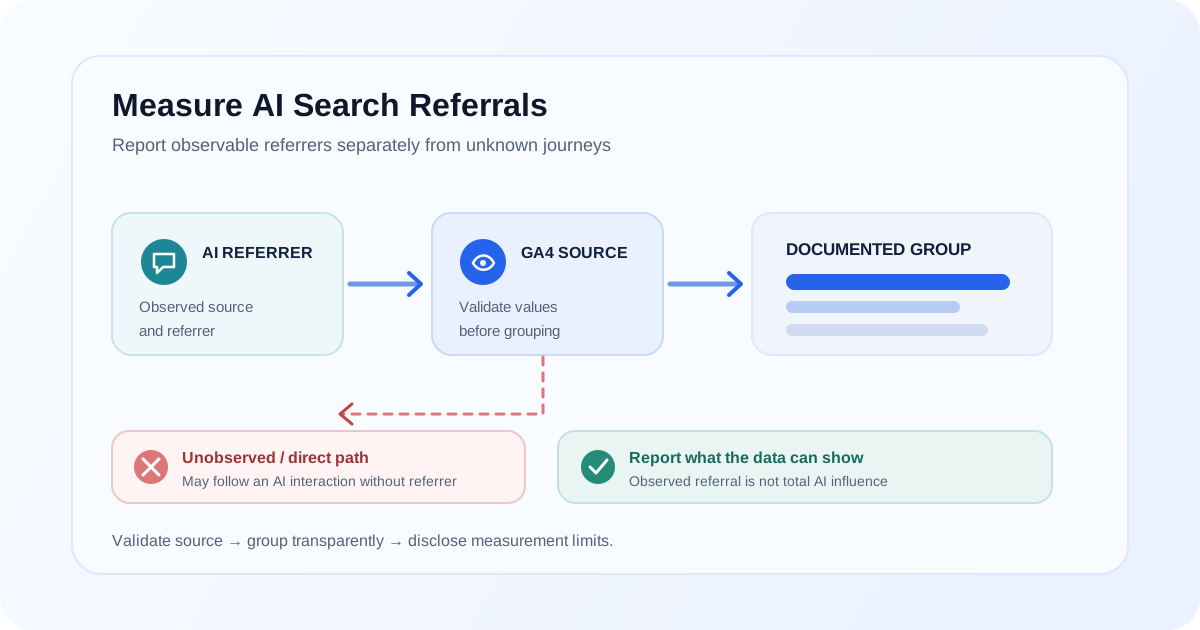
Visits from AI search and assistant experiences can be useful to monitor, but GA4 cannot identify every journey in which an AI tool influenced a visitor. A visit may appear with a recognizable referrer, arrive without one, or be mixed with other sources depending on the product, browser, sharing flow, and navigation.
The practical goal is therefore not to claim a complete count of “AI-influenced” traffic. It is to identify the referral evidence GA4 actually receives, group that evidence transparently, and keep unknown or unattributed visits separate from confirmed referrers.
Start with observed source data
In GA4, review acquisition reports using dimensions such as session source/medium or the equivalent source dimensions available in your report. Look for referral sources associated with AI services that appear in your own property. Names can vary across services and change over time; do not rely on a fixed list as if it were exhaustive.
For each candidate source:
- Check the exact source and medium values in GA4.
- Inspect the referring domain or landing-page context when available and appropriate.
- Confirm the traffic arrives at a landing page on your site and is not an internal referral or a test.
- Compare the observed session with server or landing-page evidence where your normal access and privacy policies allow.
- Record the date and source pattern; provider referral behavior can change.
Do not infer an AI referral solely from a landing-page path or a branded query. Those can be useful clues, but they do not establish the referring channel without supporting source data.
Build a documented AI-referral grouping
Once candidate referrals are validated, decide how you want to report them. You can analyze individual observed source values or create a reporting group using the available GA4 channel-grouping capabilities. Keep the underlying source values available so the grouping can be reviewed and updated.
| Reporting choice | Useful for | Watch out for |
|---|---|---|
| Individual source/medium | Seeing each observed referrer | Similar services may appear under different values |
| Custom channel grouping | Summarizing sources under a documented rule | Broad rules can capture unrelated referrals |
| Exploration or filtered report | Investigating a defined set of source values | Filters and date ranges must be recorded |
| Landing-page analysis | Understanding which content receives observed visits | Landing pages alone do not prove AI referral origin |
Use explicit criteria for the group, save the definition with its owner and review date, and periodically check for new or changed source values. Avoid changing historical interpretation silently when the grouping rules evolve.
What the referrer cannot tell you
Referral information is only one signal. A user may see a brand or URL in an AI response and later navigate directly, search for the brand, use a browser that does not pass the referrer, or visit from a shared link. Those sessions may not be identifiable as AI-origin visits in GA4.
Likewise, not every referral host that looks unfamiliar is an AI service. Confirm sources rather than labeling every unrecognized referral as AI. Report observed referrals as observed referrals, and distinguish them from broader questions about AI influence that analytics source data cannot answer by itself.
Validate the measurement setup
Before comparing AI search referrals over time, verify the basics:
- Consent and collection: Check whether the session's analytics data was collected under the site's consent behavior. Missing analytics data does not mean the visit did not occur.
- Referral and cross-domain configuration: Review whether the user moves across domains, and check referral settings for unintended self-referrals or overwritten source context.
- Campaign tagging: If your organization controls links in a specific distribution channel, use a consistent UTM convention where appropriate. Do not assume you can add campaign tags to links generated or shared by a third-party AI service.
- Session definition: Choose whether your analysis describes users, sessions, or conversions; these are not interchangeable.
- Reporting window: Use a consistent period, property, dimensions, and filters when comparing referral sources.
- Key events: Confirm that reported conversions represent the intended action and are not simply page views or failed button clicks.
For a broader event and collection review, follow the GA4 tracking audit guide. If source attribution across channels is your main question, see the GA4 attribution guide.
A practical AI referral analysis
Use a small, repeatable analysis rather than one headline number:
- Set the property, date range, session or user scope, and conversion definition.
- Export or inspect source/medium values for referral traffic.
- Validate candidate AI-related sources against actual referrer evidence and landing pages.
- Separate confirmed sources, uncertain sources, and visits with no usable source.
- Compare engaged sessions and meaningful key events using consistent definitions; do not treat raw sessions as proof of business impact.
- Review landing pages and conversion paths for the confirmed group.
- Compare periods only after accounting for changes to filters, channel definitions, consent, and tagging.
- Document the grouping rules and what the data cannot identify.
For wider AI search measurement, the AI Search Analytics service can help define reporting questions around observable signals without implying complete visibility into AI influence.
For the broader measurement framework—from referral identification through engagement, conversions, CRM, and revenue—read the AI Search Analytics guide. The guide complements this article with implementation and reporting considerations beyond referral traffic.
For a more formal breakdown of the evidence layers, see the AI Search Measurement Framework.
FAQ
Can GA4 identify all traffic influenced by AI search?
No. GA4 can report source information that reaches the property, but users may arrive through direct, organic, or unobservable paths after an AI interaction. Referral data is not a complete measure of AI influence.
How do I find ChatGPT referral traffic in GA4?
Inspect acquisition reports for actual source and medium values associated with visits, then validate candidate referrers and landing-page context. Use the values present in your property rather than assuming one permanent source label.
Should I create a custom channel for AI referrals?
It can help if you have a clear, documented source-matching rule and enough observed traffic to make the grouping useful. Preserve the original source values and review the rule when referrer patterns change.
Why does AI-referred traffic appear as direct?
The referrer may not be passed or retained through the user's navigation, browser, or sharing flow. Direct attribution does not prove that no prior AI interaction occurred.
Can I use UTMs to measure AI search traffic?
Use UTMs only where you control the link or distribution and tagging is appropriate. You generally cannot assume that third-party AI experiences will preserve or add your campaign parameters.
What should I report about AI referral traffic?
State the validated source definition, property, period, session or user scope, and conversion criteria. Separate confirmed referrals from uncertain or unattributed visits and explain that the observed group does not capture all AI influence.
Final takeaway
Measure AI search referrals as an observable source signal, not as a complete count of AI influence. Validate referrers, keep grouping rules transparent, compare consistent outcomes, and report the limits alongside the findings.
For focused workflows, continue with identifying ChatGPT traffic in GA4, identifying Gemini and other AI search traffic, or connecting AI search traffic with GA4 and your CRM.
Want a measurement plan for emerging referral sources?
A measurement review can define how to classify observed AI referrals, validate campaign and referrer data, and report what remains unobservable.